
Embroidery vs Screen Printing vs Heat Transfer
Which Should You Choose?

Freelance Graphic Designer, UK
You’ve got the design. You’ve chosen the clothing. Now comes the question: how do you actually get that design onto the garment?
Embroidery, screen printing and heat transfer printing can all produce great results, but they do very different jobs.
Choosing the wrong method can mean paying unnecessary setup fees, losing fine details in your artwork or ending up with clothing that doesn’t stand up to the way you use it.
The good news? You don’t need to become a printing expert to make the right decision.
Here’s what you need to know.
Category
Embroidery
Screen Printing
Heat Transfer
Best for
Workwear and logos
Larger print runs
One-offs and short runs
Finish
Textured stitching
Ink printed onto fabric
Design transferred with heat
Durability
Generally excellent
Generally excellent
Varies; can be less hardwearing
Small orders
Possible, but setup may apply
Often less economical
Particularly suitable
Setup fees
Digitising may apply
Screen preparation required
No standard print setup fee
Detailed artwork
Limited by stitch size
Depends on design and process
Often suitable
Popular garments
Polos, fleeces, jackets
T-shirts, hoodies
T-shirts, sportswear, workwear
My general rule
For a smart, long-lasting business logo, I’d start by looking at embroidery. For 100 identical printed T-shirts, screen printing is worth considering. For five personalised tops with different names, heat transfer is often the most practical option.
1. Embroidery: Best for Professional Workwear
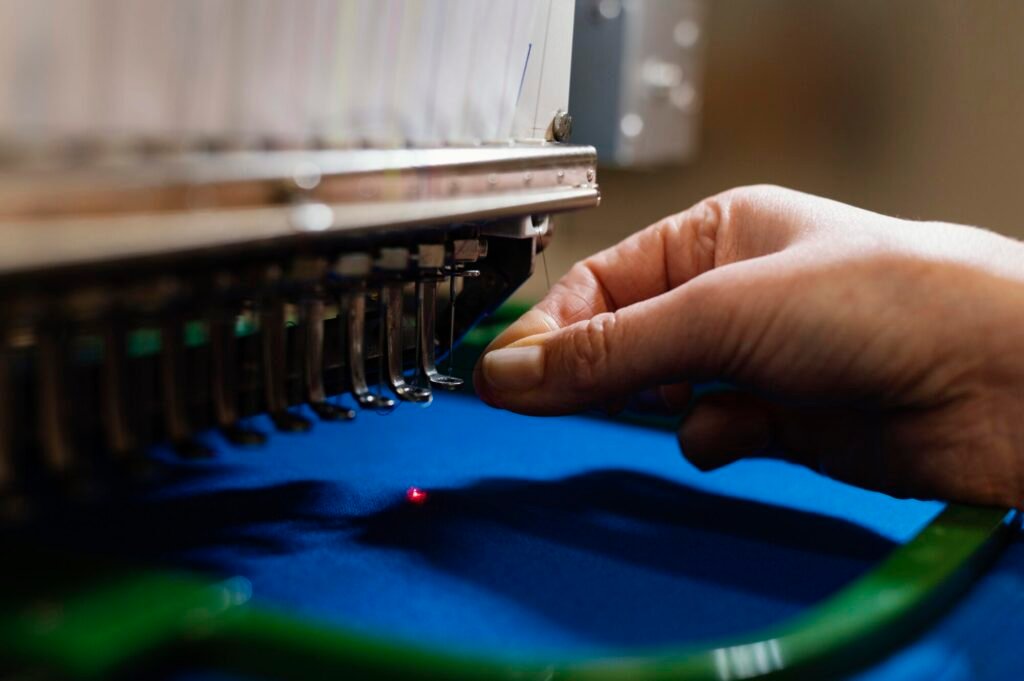
Embroidery uses a machine to stitch your design directly into the fabric using coloured thread.
Rather than sitting on top of the garment as a printed graphic, the design becomes a stitched feature of the clothing itself.
It’s the method you’ll commonly see on company polo shirts, fleeces, jackets and caps.
Why Choose Embroidery?
The biggest advantage is the finish.
Embroidery gives logos a textured, professional appearance that works especially well for small chest branding.
It’s also highly durable when produced correctly. There’s no printed graphic to peel away, although the stitching, fabric and backing still need appropriate care.
For businesses ordering uniforms that employees will wear regularly, that makes it a particularly attractive option.
Embroidery works especially well for:
Company logos on polo shirts.
Branded fleeces and softshell jackets.
Hospitality and retail uniforms.
Caps and suitable headwear.
Smart shirts and professional workwear.
What Are the Downsides?
Embroidery has limitations, particularly when it comes to intricate artwork.
Very small lettering, fine lines, gradients and photographic details don’t always translate well into stitching.
A logo that looks perfect on a computer screen may need simplifying before it can be embroidered cleanly.
There’s also usually some preparation involved.
Your design needs converting into an embroidery-ready stitch file, a process known as digitising. This can involve an initial setup charge, although a suitable existing embroidery file may be reusable for future orders.
And while embroidery is excellent for small logos, large stitched designs can become expensive, heavy or uncomfortable depending on the garment.
My recommendation: If you’re ordering branded polos, jackets or fleeces for a business, embroidery is usually one of the first options I’d explore.
For more information, take a look at my embroidered workwear service in Coventry.
2. Screen Printing: Best for Larger Quantities
Screen printing is a traditional clothing decoration method that uses a prepared screen to apply ink onto fabric.
It’s particularly popular for merchandise, promotional clothing and batches of T-shirts featuring the same design.
You’ll often see it used for band merchandise, clothing brands and event T-shirts.
Why Choose Screen Printing?
One of its biggest advantages is consistency.
Once the artwork and screens are prepared, the same design can be reproduced across multiple garments.
Properly produced screen prints can also offer excellent durability, particularly when the ink is correctly cured and the clothing is cared for appropriately.
And because the initial preparation cost is spread across the order, screen printing often becomes more economical per garment as quantities increase.
Screen printing is particularly suitable for:
Larger batches of promotional T-shirts.
Event merchandise.
Clothing brand collections.
Bold logos and graphics.
Repeat orders using consistent artwork.
What Are the Downsides?
Setup.
Screen printing requires preparation before production begins. Depending on the process and artwork, separate screens may be needed for different colours.
That means initial setup charges can make smaller orders comparatively expensive.
For example, preparing screens to print five T-shirts may not offer good value compared with using a heat transfer.
It’s also worth considering how complicated your design is.
Simple, bold artwork is often straightforward, while detailed multicolour or photographic designs can require more specialised processes.
Is Screen Printing Always Better Quality?
Not necessarily.
A high-quality heat transfer can outperform a poorly produced screen print. Durability depends on the ink, garment, curing process and care.
The strength of screen printing is that it can produce consistent, durable results efficiently at suitable volumes.
My recommendation: If you’re ordering a larger batch of identical T-shirts or hoodies, ask for a screen-printing quote before deciding.
You can explore the available options on my custom clothing printing page.
3. Heat Transfer: Best for Small Runs & Personalisation
Heat transfer printing applies a design to a garment using heat and pressure.
Depending on the particular method, the design might be produced using cut vinyl, a digitally printed transfer or another transfer material.
It’s a flexible solution for clothing that needs individual details or smaller production quantities.
Why Choose Heat Transfer Printing?
Flexibility is the biggest advantage.
If you need three T-shirts with different names, five hoodies with a custom design or a single piece of personalised clothing, heat transfer can be a sensible option.
There’s no standard print setup fee with my heat-transfer service, making it particularly useful for smaller orders.
However, if your artwork needs recreating, redrawing or significant preparation, an additional design charge may apply.
Heat transfer works especially well for:
Individual T-shirts and hoodies.
Names and numbers on sports kits.
Small batches of branded clothing.
One-off gifts and personalised items.
Detailed or multicoloured designs, depending on the transfer process.
Short-run event merchandise.
Is Heat Transfer Less Durable?
It can be, and that’s worth understanding before ordering.
Some heat transfers are more vulnerable to repeated abrasion, high temperatures and unsuitable washing or drying than a well-produced embroidered or screen-printed design.
Over time, certain transfers may crack, lift or peel, particularly if application or garment care isn’t right.
That doesn’t mean heat transfer is automatically poor quality. Professional transfer materials can perform very well, especially when matched with a suitable fabric and applied correctly.
But if you’re buying uniforms for people who work in demanding environments, wash their clothing frequently or regularly expose garments to heavy abrasion, I’d usually consider embroidery or another suitable method first.
When Would I Recommend It?
Imagine you run a small business and need four branded T-shirts for an upcoming event.
Paying for screen preparation might make little sense at that quantity.
Heat transfer allows you to produce a small order without the usual screen-printing setup costs.
Or perhaps you’re supplying sports shirts that each need a different surname and number. Again, heat transfer is often well suited to that kind of personalisation.
My recommendation: For one-offs, names, numbers and smaller custom clothing orders, heat transfer is often the simplest starting point.
Which Printing Method Lasts the Longest?
It’s one of the most common questions when choosing branded clothing, and there’s no single answer that applies to every garment.
In general, correctly produced embroidery is a strong choice for repeated wear and washing. Quality screen printing can also be extremely durable, particularly on suitable fabrics.
Heat transfers vary significantly according to the material and application process. Some hold up very well, while others are less suited to intensive workwear use.
But remember that the garment itself matters too.
A premium logo on a poor-quality T-shirt won’t make the fabric last longer.
The best approach is to consider the decoration and garment together, rather than judging either in isolation.
How to Help Your Custom Clothing Last Longer
Whatever method you choose:
Follow the garment’s care label and decoration-specific instructions.
Avoid excessive washing and drying temperatures.
Turn printed garments inside out where recommended.
Avoid ironing directly over heat-transferred graphics.
Use suitable washing products and avoid harsh treatment.
Let garments dry in accordance with their care instructions.
If you’re ordering clothing for particularly demanding conditions, explain how it’ll be worn and washed before choosing the decoration method.
Which Method Is Cheapest?
The cheapest option depends heavily on the order.
For a single customised T-shirt, heat transfer is often cost-effective because it avoids standard print setup charges.
For 100 identical T-shirts, screen printing may offer better value per garment because the preparation costs are spread across a larger quantity.
Embroidery pricing is influenced by stitch count, design size, garment type, quantity and any digitising requirements.
Here’s an example of how I’d approach three different enquiries.
Real World Examples
Example 1:
Five T-Shirts for a Small Event
Likely recommendation: Heat transfer
For a small order, avoiding screen preparation can make the process simpler and more cost-effective.
Example 2:
Twenty Premium Polos for a Business
Likely recommendation: Embroidery
If the business wants smart, regularly worn uniforms with a small chest logo, embroidery would usually be a strong choice.
Example 3:
One Hundred Printed T-Shirts for a Festival
Likely recommendation: Screen printing
For a consistent design reproduced across a larger batch, screen printing may offer better value and a suitable finish.
These are examples rather than fixed rules. The best choice still depends on the artwork, fabric and quote.
What If Your Design Isn't Suitable for the Method You Want?
This is where having a designer involved in the process can make a difference.
Not every design works equally well as embroidery, screen printing or heat transfer.
A tiny detailed logo might need simplifying before embroidery. A photographic illustration could be unsuitable for a basic spot-colour screen-printing process. A large transfer might feel too heavy on a lightweight garment.
It’s worth checking all of that before production.
I can help assess your artwork and recommend adjustments where needed, whether that’s changing the size, simplifying details or selecting a different decoration technique.
If your design needs rebuilding, I’ll explain any additional artwork costs before proceeding.
The goal isn’t simply to reproduce your design. It’s to make sure it works on the actual clothing.
So, Which Should You Choose?
If you’re still unsure, here’s how I’d narrow it down.
Choose embroidery if: You’re ordering company polos, jackets, fleeces or other suitable workwear and want a smart, textured logo that’s designed for regular use.
Choose screen printing if: You’re producing a larger batch of identical printed garments and want a consistent finish at a competitive per-item price.
Choose heat transfer if: You’re ordering one-offs, smaller quantities or personalised designs, particularly where avoiding print setup charges is important.
And if your order falls somewhere in between, don’t worry. It’s perfectly normal for a project to have more than one suitable option.
Sometimes combining methods is the best solution. For example, an embroidered company logo on the front of a garment and printed staff details on the back.
Frequently Asked Questions
Is embroidery better than screen printing?
Neither is universally better. Embroidery is often preferred for smaller business logos on polos, jackets and workwear. Screen printing can be more suitable for larger printed designs and higher-volume orders.
Is screen printing more durable than heat transfer?
A properly produced screen print can be very durable, but some professional transfers also perform extremely well. The result depends on the materials, application and care.
Is heat transfer suitable for workwear?
Yes, particularly for names, numbers, short runs and certain logos. For garments exposed to intensive washing or abrasion, it’s worth discussing durability and alternative decoration methods first.
Can you embroider a photograph?
Traditional embroidery isn’t generally suitable for reproducing photographic detail accurately. A suitable printing method may produce a better result.
Do I have to pay a setup fee?
Screen printing and embroidery can require preparation charges. My heat-transfer service has no standard print setup fee, although artwork preparation may cost extra if your design needs redrawing.
Can I use different printing methods on the same garment?
Often, yes. For example, embroidery can be used for a small chest logo and a suitable printing method for a larger back graphic, provided the garment and production requirements allow it.
Need Help Choosing the Right Method?
There’s no need to make the decision alone.
Whether you’re ordering a single personalised hoodie, embroidered workwear for your team or a batch of promotional T-shirts, I can help you find the right combination of garment, decoration method and budget.
I’m based near Coventry and work with customers across the West Midlands, with UK delivery available.
Explore my custom clothing printing services or find out more about embroidered workwear in Coventry.
Or simply send over your design, quantity and what you’re hoping to achieve.
Good clothing starts with the right choices. I’ll help you make them.